
The Tazewell Owner-of-Record Fields
The Commissioner of the Revenue builds the assessment roll from the clerk's instruments. Deeds, deeds of correction, lists of heirs, wills, and related records all feed the update. The county publishes no live parcel card. So confirm field names and their order with the office itself. Treat the inventory below as a checklist when you request the current record. It is not a guarantee of what appears online.
| Owner name | Ask the Commissioner for the current assessment owner field |
|---|---|
| Mailing address | Tax-notice destination; it may differ from the property location |
| Situs address | Physical location tied to the assessment parcel |
| Tax-map number | Parcel key; example 094A3A0067 is verified on an indexed map |
| Deed reference | Confirm instrument and recording date with the Circuit Clerk |
| Value and land-use fields | Assessment details to request from the Commissioner |
An owner of record is the name tied to the assessment file. It is not necessarily the person living there. The mailing address exists for tax notices. It may belong to an owner in another state or to an entity. That makes it a clue rather than proof of residence. For an important transfer, pull the latest recorded deed. Its date and legal description can be more current than the assessment card.
Where Tazewell's Current Owner Appears
The county's Commissioner real-estate page names the public assessment source and describes the office's role, though it posts no live parcel card. Call 276-385-1235 or visit Suite 301 to request the current owner name, situs, mailing address, tax-map number, and assessment year for a parcel.
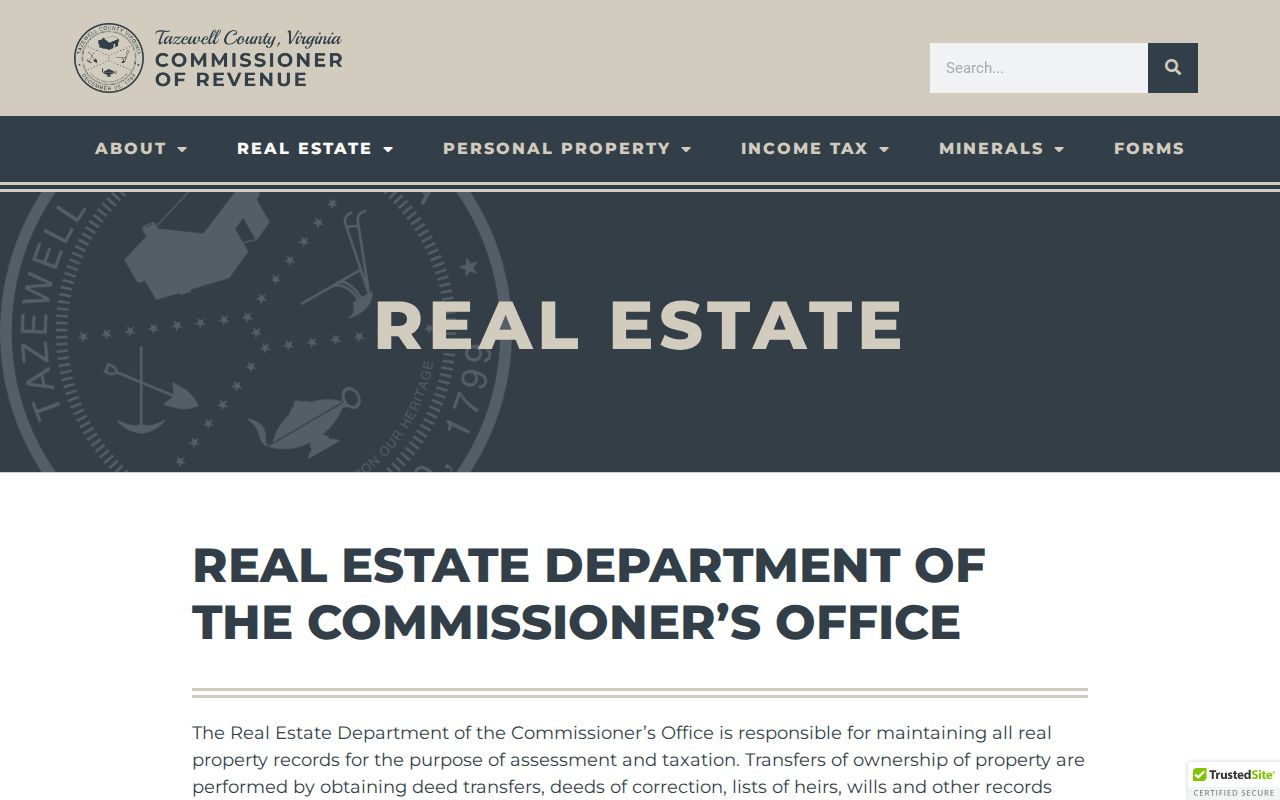
The screenshot shows the public office route only, not an individual owner result. Ask the custodian for the parcel record itself.
Verify the Current Tazewell Owner
Start with the assessment record to identify the parcel. Then compare it against the newest instrument in the Circuit Court Clerk's land index. Tazewell's SRA instructions describe remote land-record access for subscribers. The COVERS search fields are not visible online, though. A clerk terminal, a phone inquiry, or a copy request works. Use one when the online image is out of reach.
- Ask the Commissioner for the present owner name and the parcel's tax-map number.
- Search the clerk's grantor-grantee index for the latest deed and note its grantee and recording date.
- Compare the instrument's legal description with the same tax-map parcel before treating the names as a match.
- If an LLC appears, check its official SCC entity record; if an estate appears, ask the clerk's probate division.
- Owner of record
- The party named in the current assessment record.
- Vesting
- The way a deed states an interest is held, such as by an entity or fiduciary.
- Registered agent
- The contact listed for a Virginia business entity, not necessarily the parcel's occupant.
A New Deed Can Lead the Roll
Tazewell County publishes no fixed closing-to-roll update period. The Commissioner says transfers are processed from deeds, correction deeds, lists of heirs, wills, and related clerk records, but states no number of days or months. For a recent sale or transfer, the deed's recording date is the more current public event. Treat the assessment card as a separate update stream. A deed's date is not the date a tax bill was last paid. Keep those questions apart. The clerk records the transfer, the Commissioner maintains the assessment roll, and the Treasurer tracks payment and escrow. When a name differs across the three offices, compare the records one by one. Do not assume a single field is wrong.
Mailing and Situs Are Different Tazewell Fields
A situs address locates the parcel itself. A mailing address tells Tazewell County where to send the tax notice. Rural roads, town names, and postal routes mean the two often differ. Neither field proves occupancy. To confirm the current owner, match on the tax-map number and legal description as well as the street address. A post-office box or distant mailing town will not then obscure the result. If the street address will not resolve, try the county and town versions. Or use the map for orientation. The county offers no full ZIP-to-town boundary list or address history database. A local permit can also sit with a town office. The parcel remains in the county assessment and deed systems.
Entity Names on a Current Owner Record
An LLC named on a Tazewell assessment or deed can be checked in Virginia SCC's Clerk's Information System by entity name. It can also be checked by entity ID. The public result may show entity type, address, formation date, status, and status date. It may also show the registered agent. That clarifies the business name. It does not name every person behind the entity. It also does not prove the entity owns a particular parcel.
Use the SCC record as an identity check. Then return to the Circuit Clerk land instrument for the parcel. A trust, an estate, or a list of heirs may call for different clerk records. Keep the current owner question in the present tense. Compare document and record dates without rebuilding a full historic chain of title.
The Virginia SCC entity lookup is the state business-record route.
Before you treat an entity as the owner of record, check that its name lines up with the grantee and parcel description on the deed in the Tazewell County property records.
Contacting a Tazewell Property Owner
The mailing address on a tax record is a notice destination. It is not proof that a person lives at the parcel. Virginia's Safe at Home program gives eligible survivors a substitute address. That substitute can affect government-record displays. Respect protected fields and redactions. Direct any safety concern to the proper custodian rather than working around a privacy measure. Voter registration is a separate public lookup. It cannot establish parcel ownership. The Virginia Citizen Portal route summarized on the county records overview concerns an individual's civic record, not the title holder or occupants of a home.
Lawful use. Use Tazewell owner information for legitimate property matters and due diligence. Do not use it to stalk, harass, or harm anyone.